Big-box charts say 60 or 72 inches wide. Iron stock sizes say otherwise. Here's how to measure, choose a style, and prepare for install day.
Share:
Summary:
You’ve outgrown the single door. Maybe furniture never fits through it, or the entry is drafty and you’re tired of fighting it, or the house just deserves a wider welcome. So you look up double front doors, find a chart that says 60 or 72 inches, and figure the hard part is picking a style. It usually isn’t. Across Middlesex, Bergen, Monmouth and Essex County, openings vary, homes vary, and iron doors follow their own size rules. This guide walks through what sizes really look like, how to match a style to your house, and what happens when our crew shows up.
Most retail guides list double front doors at 60, 64 or 72 inches wide and 80, 84 or 96 inches tall. Two 36-inch doors side by side, the 6’0″ pair, is what most people picture. That works well for fiberglass and wood units built around those big-box sizes.
Iron plays by different numbers. One New Jersey seller publishes stock iron sizes like 63×81, 66×96 and 74×96, and plenty of iron work is built to order anyway. So the 72-inch door in your head may not match anything made in iron, and it may not match the opening in your wall either. That’s why we start with a measurement instead of a catalog page. A door built to your opening always beats an opening reworked to fit a door.
Three measurements get mixed up constantly, and that’s how wrong doors get ordered. The slab is the door panel itself. The unit is the door plus its frame. The rough opening is the framed hole in your wall, and it’s the number we need to fabricate correctly.
Measure the rough opening, not your old door. Take the width at the top, middle and bottom, take the height on both sides, and write down the smallest number in each direction. Older homes settle and drift out of square, which happens a lot with the colonial and Tudor houses across Bergen and Essex County, so those readings often don’t match. If yours don’t, that’s useful information, not a problem.
Sizing guides give you a rough sense of how openings pair with doors. An opening around 63 to 67 inches wide takes a 5’0″ pair, and one around 75 inches and up takes a 6’0″ pair. Those numbers are written for prehung units, and iron doesn’t always land on them.
If you’re in Middlesex, Bergen, Monmouth or Essex County, we’ll come out, measure and give you a quote at no charge. That takes away the biggest worry in this whole process, which is ordering a door that doesn’t fit. While we’re there, we’ll settle the swing. Choosing inswing or outswing depends on your porch roof, your vestibule and how much room you have inside. It’s far easier to decide before the door is built than after.
Often, yes, though it’s a bigger job than swapping one door for another. Going from single to double means widening the opening. That involves a new header above it, new framing at the sides, and a careful look at what’s behind the wall. The header carries the load over the opening, so it has to be sized for the wider span.
Then there’s the weight. A double iron door can weigh several hundred pounds, and one contractor guide puts it at 300 to 500. Hinges and framing have to be built to handle that load. This is the real difference between a double door and “two single doors.” The wider opening, the weight and the hardware all change together.
Permits come up a lot, too. Replacing a door in the same opening is generally treated differently from widening one, and widening usually involves structural work. The rules belong to your town, so call your municipal construction office before you commit. That applies across Middlesex, Bergen, Monmouth and Essex County, and it’s a five-minute call that can save you from a stalled project.
When we measure, we point out what we see in the wall so the structural part isn’t a surprise later. If the opening needs work, we build that into your schedule alongside the 4 to 6 weeks custom doors typically take. Planning for both at once keeps the project moving instead of stopping and starting.
Want live answers?
Connect with a Iron Door Kings expert for fast, friendly support.
Double iron front doors don’t belong only on oversized or ultra-modern houses. We see them on colonial, Tudor and contemporary homes throughout Middlesex, Bergen, Monmouth and Essex County, and the style choices are what make them feel right for the house.
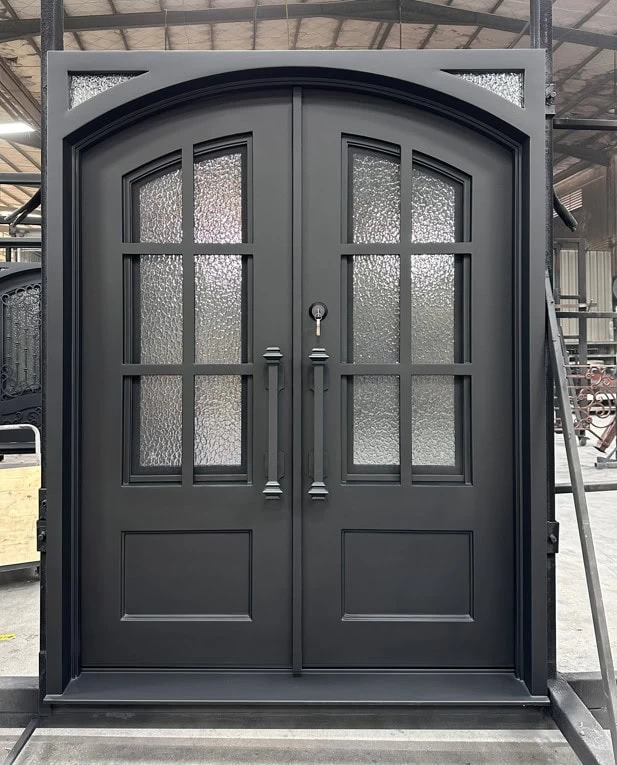
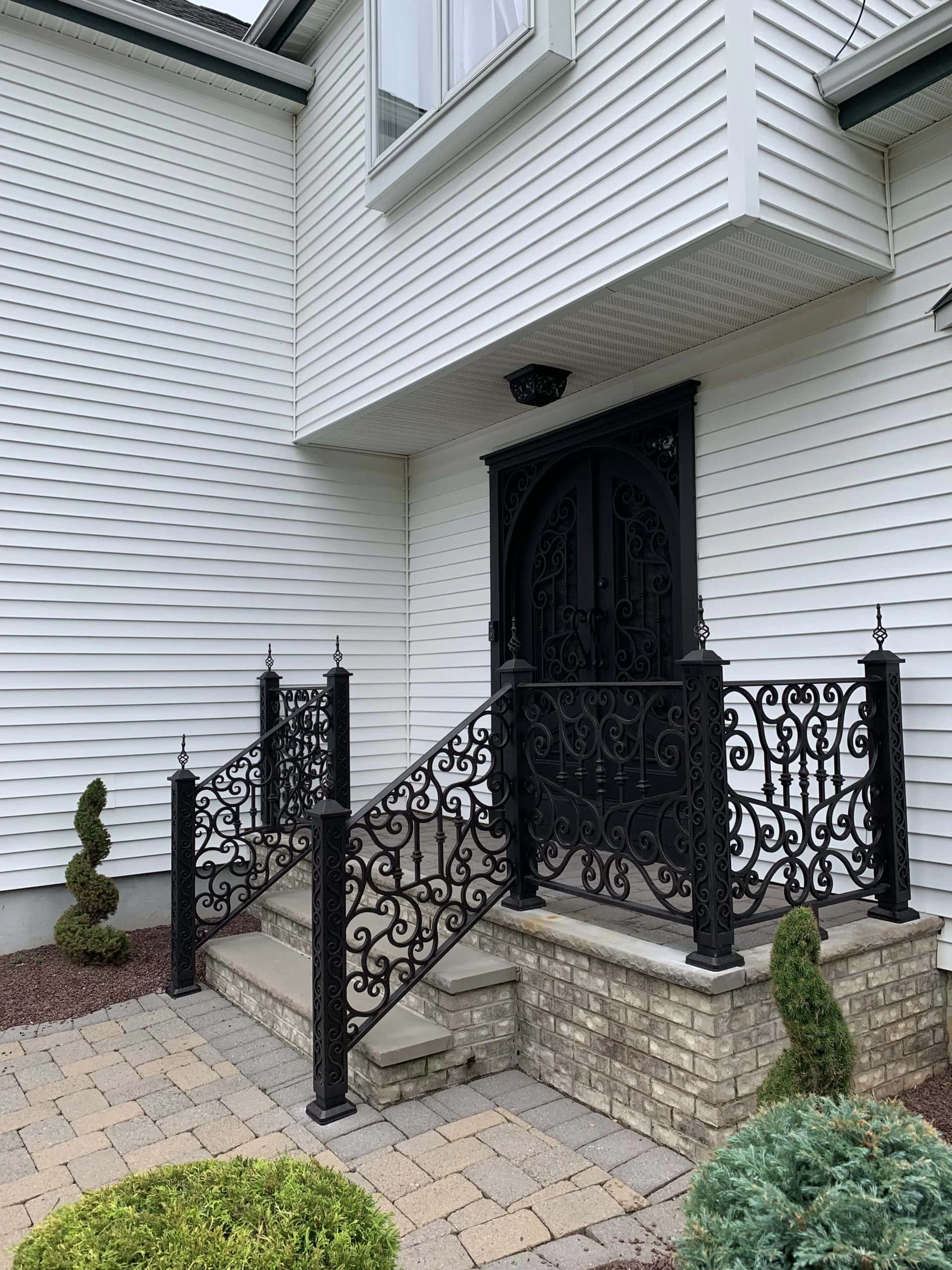
A colonial usually looks best with something symmetrical and restrained, like simple scrollwork and divided glass. A Tudor can carry an arched top and heavier detailing. A contemporary home often wants clean lines and plenty of glass with very little ornament. Sidelights and transoms bring in more light, and you can pick a square top, eyebrow or full-round shape depending on your entry.
We offer both pre-designed doors and fully custom ones, so you can start from a proven design or build something one of a kind.
Start with the material question. Steel double entry doors are the lower-cost route, and national cost guides put steel doubles at about $1,200 to $4,000 and iron doubles at about $3,000 to $6,000. Glass, size and scrollwork move those numbers quite a bit, which is why we’d rather quote your exact opening than guess.
Next, ask about the thermal break. Iron conducts cold, so a door without one can feel like a cold wall in January. Ask for the NFRC-rated U-factor for the exact door and glass combination, and get it in writing. A vague “thermal upgrade” isn’t an answer.
Then there’s the finish. People often ask if iron rusts in New Jersey, and the honest answer is that a good multi-layer finish holds up well, though nothing is maintenance-free. Humid summers, freeze and thaw cycles, and road salt are normal in Middlesex, Bergen, Monmouth and Essex County, and homes closer to the shore deal with salt air as well. Check the finish once a year, especially around the handle and hinges, and touch up chips early.
Finally, read the warranty before you order and ask who handles the install. Some sellers only ship a door and void coverage if anyone else hangs it. We install our own doors, and our crew is certified specifically for iron door work.
Custom doors typically take about 4 to 6 weeks, and the process runs in a clear order. It starts with the free measure and quote. Our in-house design team then works out style, glass and swing with you, and a dedicated project manager stays your single point of contact until the door is hung. You aren’t chasing a designer, a fabricator and an installer separately. Pre-designed doors can be a quicker route, and we’ll give you the real timeline when we quote.
On install day, our crew shows up on time and works efficiently. We remove the old door, prep the opening, set and hang the new doors, then seal everything up, adjust the hardware and clean up the area. If you’re widening a single entry, the framing and header work comes first, which is why we flag it at the measure.
Timing matters more than most people expect. Drafty doors drive a lot of replacements in late fall and winter, and an order placed then often lands in early spring. If you’re hosting a graduation or holiday gathering, count backward from that date, leave room for any structural work, and order early.
We’re based in Englishtown in Monmouth County, and we install across Middlesex, Bergen, Monmouth and Essex County. Plenty of sellers are catalog-only or ship-only. Having the same team handle design, build and install means you always know who to call, in whichever of those counties you live.
Here’s the short version. Standard sizes come from wood and fiberglass, and iron often runs differently. The only number that counts is your rough opening. Widening a single entry means a new header, stronger framing and a call to your town’s construction office. And the best double iron doors are the ones with a real thermal break, a finish you can maintain, a warranty you’ve read and a crew that’s directly responsible for the install.
If you’re weighing double front doors for your home in Middlesex, Bergen, Monmouth or Essex County, Iron Door Kings can come out, measure the opening, talk through style and swing, and give you a real number. No guessing from a chart. Reach out to Iron Door Kings and we’ll get you started.
Article details:
Share:
Continue learning: